


Responding to member concerns, the CBI has been raising the increasing cost of employment with government. Recently we published an opinion piece in the Observer setting out why we can’t tackle the cost of living crisis for households in the UK without tackling the cost of doing business.
The impact on hiring and investment
As government attention pivots from growth to the cost of living, there is a real risk they repeat the familiar temptation to load more costs onto business in order to fund short-term support for households. But when those costs are pushed onto employment, they do not disappear. They feed back into hiring decisions, investment plans and ultimately into the opportunities and wages available to individuals. We’re already seeing this play out in the CBI’s business surveys: hiring intentions have been negative for eighteen months, and plans for investment in the year ahead are languishing at their weakest levels since the COVID pandemic.
Official data shows that the unemployment rate in the UK is currently at a 5-year high and unemployment for young people in the UK is now above the EU average for the first time on record.
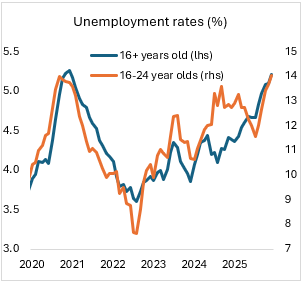
Source: ONS data with CBI calculations
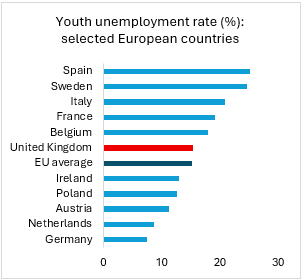
Source: OECD data
An unsustainable cumulative burden
This is unsurprising, given that employment costs have increased significantly in recent years. Increases in employer National Insurance Contributions, alongside large rises in the National Living Wage, have unequivocally made it more expensive to create jobs. The Employment Rights Act is also expected to add further costs to business employment decisions and increases the risks of taking on new workers, especially those with more complex or missing employment backgrounds. These changes combined have made it relatively more expensive to employ younger people and those in lower paid roles - precisely the jobs that help people move from inactivity or unemployment into work and start progressing up the labour market.
We estimate the rise in Employer NICs will add over £17bn to private sector labour costs this year, increasing the total cost to businesses to over £100bn annually. National Insurance contributions and pension contributions, sometimes known as ‘employers social contributions’, matter when firms are making employment decisions and setting wage rises. Combined together with wage rates, (shown below as ‘total compensation per employee’), they represent a more accurate reflection of the cost of employment to firms.
The wedge between productivity vs wage growth
In a healthy economy, productivity per worker and total compensation per employee should move broadly in line. In the UK, productivity growth has flatlined, real wages have struggled to recover, yet total compensation has continued to rise. The wedge between the pay that employees take home and what it costs to employ them has widened sharply, driven by higher NICs and pension contributions. That wedge explains why businesses feel increasingly squeezed even in periods when headline wage growth looks weak.
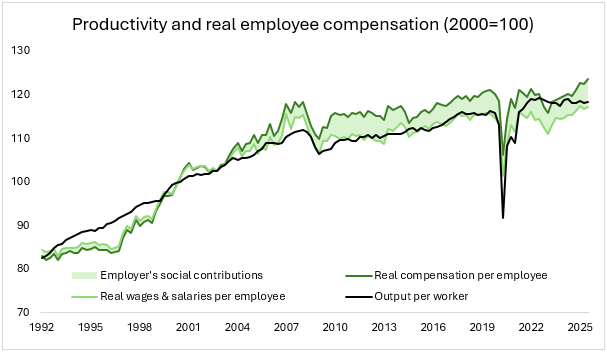
Source: ONS
Corporate profits are being squeezed
Increasing taxes on business does not come without consequences, as the impact on employment and hiring intentions shows. Moreover, alongside this increase in employment costs (and increases in energy and other commodity prices), corporate profits in the UK are now at their lowest level since before the financial crisis (as a proportion of GDP). When businesses are squeezed, this reduces the funding available for investment, and investment is what ultimately drives productivity, job creation and sustainable pay rises.
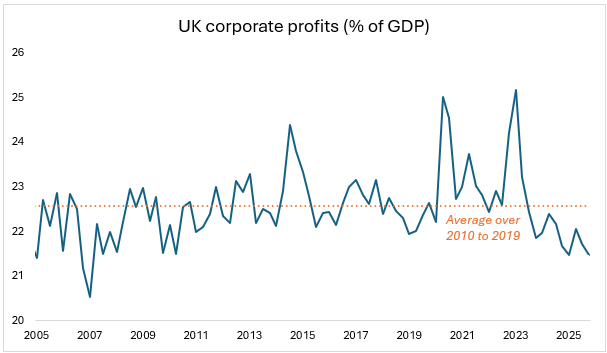
Source: ONS data with CBI calculations, UK corporate profits as measured by Gross Operating Surplus (profits before taxes, interest and depreciation)
Government must take action on employment costs to unlock growth
It is therefore no surprise that, with the cost of employment rising and profits under pressure, the labour market has begun to soften. If we want to get back to a healthier labour market with rising employment and sustainable pay increases, we need to tackle the cost of employment in the UK. That means tackling the growing wedge between pay and the cost of employment, being honest about the limits of what firms can absorb, and creating an environment where investment in productivity is encouraged rather than crowded out.
In the short-term, there are practical actions that the government can take to give employers space to grow and create more jobs. Firstly, re-thinking the pace of current National Living Wage increases, especially for the young.
Second, avoid costly and burdensome implementation on the Employment Rights Act by recognising that hours during seasonal peaks can’t be offered all year round, and being more pragmatic about how often a trade union that doesn’t represent your workforce can expect access.
Third, unlock the potential of the Growth and Skills Levy to fund the scale of training needed for an AI-enabled economy, by putting all of the money that it raises into the skills system.
The labour market can be a UK strength again, but we need a mindset shift and to recognise the impact the growing cost of employment is having both for businesses but ultimately on individuals themselves.
What we’re doing and how you can get involved
We’ve submitted detailed responses on the implementation of the Employment Rights Act — shaped by 130+ members. Five further responses are in draft and consultation on key topics like ‘guaranteed hours’ is due to begin soon. We are pushing to protect flexibility, avoid one-size-fits-all pay frameworks, and ensure reforms are proportionate and workable — helping prevent unintended cost, risk and operational burdens.
Finalising further submissions on industrial action, flexible working, statutory recognition, fire & rehire and collective consultation — all grounded in member evidence.
- Members: Join our Employment Rights Working group to shape CBI policy that delivers change.
- Non-members: pro-business legislation doesn’t happen by accident. If your business is impacted by the cost of doing business, join us to drive change.